Thursday, January 25, 2007

(Museum) Architecture and Cultural Identity

The majority of my last post was taken from an editorial that I wrote for a Public History class exercise back in mid-October, 2006. Recent experiences have caused me to reflect in different ways on the case of the ROM's Michael Lee-Chin Crystal.

The architecture that a community chooses for its major cultural institutions reveals, of course, much about the values the society, community and particular designers want to infuse in that institution. The ROM website features a couple of interesting pages on the Museum's history; they teach that the original building was opened to the public on 19 March 1914. On the left is a photograph of a hand-lettered and illuminated presentation address, given as a gift by Toronto artist A.H. Howard to the Governor General of Canada on the occasion of his official opening of the ROM.

We are all familiar with the notion that, when public museums began to emerge in force in the 19th and early 20th centuries, many of their architects turned to Neoclassical, or Gothic architectural forms.[1] New York's Metropolitan Museum of Art (opened in its current location in 1880), American Museum of Natural History (opened 1877), as well as The Cloisters (a museum devoted to Medieval Art, opened in 1914 and now a branch of the MET) provide a few examples. We all know that there is nothing indigenous about Classical and Medieval art & architecture in North America. Borrowing those European forms, however, lent credibility and authenticity to our young nations' new institutions.

Much, I'm sure, has been written on Architecture's role in Nation-building in the late nineteenth, and early twentieth centuries in Europe. For a couple of accessible examples, see Heather McMahon's M.A. Thesis (Central European University, 2004) on constructing a Hungarian national architectural style at the turn of the 20th century, and the blog post of South Hadley, Mass., Ph.D. student "Nathanael" on "A Catholic Style, A German Style" in the Rhine River region.

I think that "nation-building" through the use of value-laden architecture also happened on a much smaller scale than that of grand Gothic Cathedrals and national museums. American horticulturalist and writer Andrew Jackson Downing's 1850 book The Architecture of Country Houses, for example, aimed to educate the American middle class about the virtues of "uniting a simple and chaste Gothic style with forms adapted to and expressive of our modern domestic life." Downing ascribed a moralizing function to romantic architecture - one that he hoped would strengthen Americans' moral virtue.[2]

What's really interesting, though, is that in the midst of all this turn-of-the-century boasting about the value of old European forms in North American contexts, American librarian and museum director John Cotton Dana wrote in 1917 about "The Gloom of the Museum." Of particular interest are his arguments about how the museum edifice should be in harmony with its surroundings. His argument is worth quoting at some length here:

"A building of steel and concrete in a modern American city is not made an appropriate home of the fine arts by placing on its front the facade of one or the facades of half a dozen Greek temples or of 15th-century Italian palaces (...) In time we shall learn to insist that great public buildings like libraries and museums be erected as such and not as imitations of structures developed for quite other purposes, in other cities, in other times, and under limitations as to material and method by which we are no longer bound."[3]

It's remarkable that Dana's ninety year-old argument resonates when we think about the current trend of hiring big-name architects of international fame to renovate our museums. The ROM crystal and the Denver Art Museum extension are, in my mind, imitations of Libeskind's earlier designs - ones developed for other purposes, in other times, and in other cities. Are those who approve these design decisions trying to project a certain image for our cities, just as was Downing? Are they involved in some kind of contemporary "nation-building" themselves? Libeskind's crystal and another current, large-scale renovation, Frank Gehry's plans for the Art Gallery of Ontario will surely boost Toronto's reputation for 'world-class' architecture. But what cost do such unapologetically cosmopolitan projects as Libeskind's exact? Are there drawbacks to housing the ROM's collections in a building that could just as well be in Berlin? I'm still trying to think this problem through. Any thoughts?

-----------------------------------------------------------------------------------
[1]. As is likely fairly clear, I am no art history expert. The MET is a bit of a confusing case for me: I've seen reference to it as an example of Neoclassical architecture, but also to it as an example of Gothic Revival. Do any art historians out there care to clear up my confusion?

[2]. See Downing, The Architecture of Country Houses (New York: Appleton & Co, 1850), 440, as cited in Elizabeth Bradford Smith, ed., Medieval Art in America: Patterns of Collecting 1800-1940 (exhibition catalogue) Palmer Museum of Art, Pennsylvania State University (University Park, PA, 1996), 77.

[3]. Dana, "The Gloom of the Museum," in Gail Anderson, ed., Reinventing the Museum: Historical and Contemporary Perspectives on the Paradigm Shift (Walnut Creek: AltaMira Press, 2004), 22.

Wednesday, January 24, 2007

Museums should avoid designs of the past, demand innovation

On the left is a projected view of Daniel Libeskind's new crystal design for the Royal Ontario Museum's extension. The image is taken from Libeskind's website. The ROM is touting the current construction of this extension as part of the institution's total rebirth. "Renaissance ROM is one of the most important architectural commissions of our time," boasts the ROM's website. The project, the website continues, "...will simultaneously restore one of Canada's historic landmarks to its original splendour and create a new signature building for the city of Toronto."

Sounds fantastic! I love the ROM. I was a Saturday Morning Club-goer for years, and that experience continues to make me feel at home in the Museum. [1] The ROM was an integral part of my unique experience of growing up in Toronto. I'm glad that Libeskind's design was tailor-made for the great city.

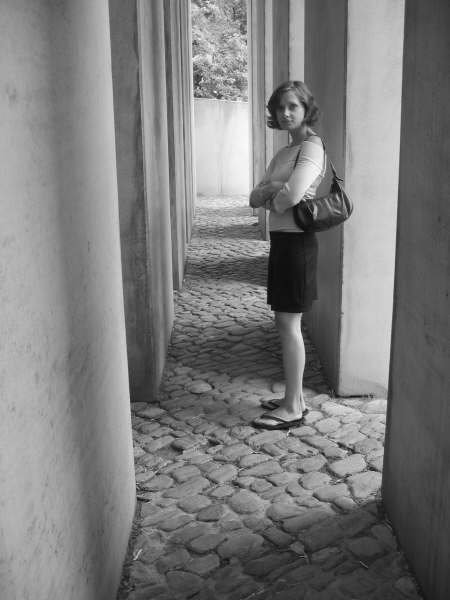
Or was it? On the right is a 2006 construction photo taken from Daniel Libeskind's website. It depicts his extension to the Denver Art Museum. Hmmm. The geometric projections and intersecting line design features look familiar, don't they? Below is a photo of another of Libeskind's unique designs: The Jewish Museum, Berlin, opened 2001 in the downtown core of the German capital.

“I was inspired by the mountains”, is how Libeskind explained his design for the Denver Art Museum, opened 7 October 2006. Curiously, there are no mountains visible from downtown Berlin. When the Jewish Museum opened in 2001, Libeskind explained that its design evoked the absence of Berlin’s Jewish citizens. There are no mountains nearby Toronto, and Libeskind has stated that his “Renaissance ROM” design illustrates the relationship between history and the new.

Is the concept of site-specific design alien to Mr. Libeskind? Does not a city’s particular history and culture demand a museum that will honour its individuality? I’d bet a whole pile of Denver Nuggets that few Denverites think their urban culture is interchangeable with that of Torontonians, or Berliners. Yet within two years, two of our major North American Museums will have chosen NOT to support cutting-edge design in their major architectural additions. Instead, they will have relied on near-identical architecture to communicate wildly different messages. Our ROM could have avoided relying on past designs. It could have, instead, opted for architecture that reflected Toronto’s unique past, and particular cultural heritage.

As intelligent citizens of the world’s dynamic cities, we need not support architectural redundancy. If we are informed of great international designs, we can demand that our own cultural institutions – as well as our municipal and provincial governments – embrace architectural innovation.

--------------------------------------------------------------------------------
[1]. The ROM's Saturday Morning Club offers a number of really neat educational programs for kids. Each program runs for approximately 8 weeks, with 3-hour long meetings every Saturday morning.

Thursday, January 18, 2007

A little bit of history (and museology) repeating

I'm currently taking an art history course on how North Americans have collected medieval Art, and how we've displayed it in our museums. We're also looking at some of the challenges and issues we face when we mount medieval art exhibitions for diverse audiences today.

We spent Wednesday's seminar talking about the nineteenth century beginnings of individuals' collecting of medieval art. I learned that some of the issues we've encountered in our public history context about authentic, versus replica artifacts arose in that early collecting period in America.

Apparently, when the first big public art museums began to be established in the States after the Civil War, art was largely thought of as an educational tool for the masses. We know this - we're familiar with the notion of fine art having some moral effect on its audience. But did you know that, at that time, Americans weren't exactly sure of how to approach the public display of European art? Museum officials were a little uneasy with oft smooth-talking European dealers, and their ability to swindle. So, American museums of the late 19th century preferred displaying reproductions of great works of European art.[1]

It's interesting to think that those museum officials thought reproductions could effectively communicate important moral lessons. For them, then, the authenticity of the piece was subordinate to a more general message. The contemporary writings on collections and pedagogy that I listed in my last blog post seem to embody very similar notions.

And we think we're being avant-garde when we reflect on the emerging "post-museum" that reimagines museums' identity.[2] It's all just little bits of history repeating.

--------------------------------------------------------------------------
[1] All of this information (though corroborated by my Professor, Dr. Kathryn Brush, and by my classmates, all graduate students in art history who know worlds more about this stuff than I ever, ever will), is outlined in a really neat exhibition catalogue. We're using this catalogue, itself put together by Penn State grad students, as one of our core textbooks: Medieval Art in America: Patterns of Collecting, 1800-1940 (University Park, PA: Pennsylvania State University, 1996). See page 22 for this particular reference. This catalogue is neat because it displays medieval art, but it also explains Americans' evolution of taste in collecting. The exhibition it documents was an exhibition about past exhibitions.

[2] Yes, "post-museum." Sigh. See Eilean Hooper-Greenhill, Museums and the Interpretation of Visual Culture (New York: Routledge, 2000), preface. She writes that the "post-museum" is emerging in the 21st century. It is a place where the visitor is active, and where that visitor determines meaning in the museum.

Move over, Collections

In last Tuesday's Introduction to Museum Studies class, we discussed the centrality of collections in defining museums. In last Wednesday's Public History class we thought about criticism the Canadian Museum of Civilization received in its early days for seemingly favouring other elements of its presentation - such as live performances, exhibits that replicated places of the past, and some replica artifacts - over its collections of authentic artifacts.

The last museum visit I made was to the McCord. I wasn't particularly moved by the museum's Simply Montréal permanent exhibit until I saw an element that bore direct relevance to my life experience. It was stationed near the exhibit's end. It wasn't an authentic artifact that caught my eye. It was a simplified map of the city, apparently constructed (out of some kind of plywood) specifically for the exhibit. The map was colour-coded according to predominant languages spoken per area, and was fixed to a wall below a silent film clip that featured Montrealers 'on the go' in the city.

This component of the exhibit moved me because it spoke directly to my life experience. The video clip featured shots from my neighborhood. That was my hook. It didn't come from an 'authentic' historic artifact. What's more, only after that "aha!" moment did I care to pay attention to the "big idea" of the Simply Montréal exhibit. The "big idea", paraphrased, is this: Montréal is a neat city that owes its dynamism to its rich history. The McCord evinces that rich history through First Nations objects, Notman photographs, and a diverse array of everyday objects of Montrealers such as apparel, and household items.

These objects are incredibly varied. To ensure that its visitor has an "aha!" moment like mine - or to make sure that moment comes before the exhibit's end - the McCord could make its curatorial voice louder. I believe it could do this by including more teaching tools, like the map and video, in the exhibit. Without such tools, I argue, visitors may not understand the big "so what?" that links the collection.

Move over, collections! Yes, yes, you reside at the museum's core, but share the spotlight with pedagogy. I'm adding my voice to some comments my colleagues have made. They have referred to the Canadian Museum of Civilization as example. Alex has reflected on the need to balance "flashy interactives" and artifact replicas with authentic collections. Carling has insisted that collection and interpretation is what "makes a museum a museum." Additionally, I argue, it is constructive to think of pedagogy as extending beyond interpretation in the exhibit itself. We all know that funding crises plague museums. With that important reality in mind, I say that, ideally, museums' educational programming can work to effectively integrate the museum into its community.

Some things I've read the past week do a great job of articulating the need to place pedagogy at the museum's core. They all address the ways to make the museum relevant to communities today. The following ideas have inspired me to think of the museum in different ways:

1. Eilean Hooper-Greenhill argues for the museum as a "social and cultural institution." Museums can be important (and necessary, even) cultural centres. She writes of research in England that uncovered a common notion among "ethnic" communities that museums ignored Black contributions to British life because, it was thought, those museums continued a colonial view of the past. The same study, however, also confirmed that said communities thought museums could be places where Asian and Afro-Caribbean parents could meet to discuss their own cultural values. [1]

2. E.H. Gurian has argued that the essence of a museum is not objects. Rather, it is a "place that stores memories." Objects are necessary for the museum, but they are not sufficient. What people really care about is ownership of a story. They don't care about ownership of the artifact itself. [2] If museums are less object-based, artifacts are props. Again, they are essential to a museum's purpose, but only in so far as they make an exhibit's 'big idea' tangible. The foundational definition of the museum, Gurain writes, will not centre on objects, but rather on the institution as a place for storytelling "in tangible sensory form." Providing a story is to perform a community service. As such, museums are "social service providers."[3]

3. Stephen E. Weil's writing can help us think further on these kinds of ideas. While museums once focused predominantly on collections (development, research, conservation, etc.), he writes many now have shifted that focus to public service. Collections, he continues, are no longer an end in themselves. Instead, they are a means to that end. Museums should ask about each artifact's utility: "how might this object be useful to the museum in carrying out its institutional mission?" In this way, museums subordinate collections to a bigger vision of the museum's function in the community. [4]


------------------------------------------------------------------------------------
[1]. Eilean Hooper-Greenhill, Museums and the Interpretation of Visual Culture (New York: Routledge, 2000), 7.
[2]. E.H. Gurian, "What is the Object of the Exercise? A Meandering Exploration of the Many Meanings of Objects in Museums" in Gail Anderson, ed., Reinventing the Museum: Historical and Contemporary Perspectives on the Paradigm Shift (Walnut Creek: AltaMira Press, 2004), 270-1.
[3]. Gurian in Anderson, 282-3.
[4]. Stephen E. Weil, "Collecting Then, Collecting Today: What's the Difference?" in Anderson, 290.

Friday, January 12, 2007

Keeping up with Canada

Words of the late black American poet, June Jordan, can remind us of the limits of some of our national museums. They may even indicate one of the major challenges facing Canadian museums today:

"Take me into the museum and show me myself, show me my people, show me soul America. If you cannot show me myself, if you cannot teach my people what they need to know (...) then why shouldn't I attack the temples of America and blow them up?" [1]

Are we terribly out of touch with our country's social, cultural, economic and intellectual realities when we mount permanent exhibitions that depict and interpret Canadian history? Do you think that any interpretation of our past becomes out-of-date the moment after it is fixed to a museum wall? What if our national museums featured nothing but temporary exhibits? Taking a cue from theatres, all of these temporary exhibit spaces could be designed with flexibility in mind, for transformation to best suit successive exhibits.

Canada is constantly changing. Our political landscape shifts, bringing with it multitudes of new attitudes - dissenting and assenting - that affect our intellectual climate. New immigrants settle in Canada, and affect our cultural and social realities. The Canada that my thirteen-year old sister knows now is different from the one I knew at her age, and our present realities, of course, determine the ways we interpret the past. Do you think the steady change of exhibitions and exhibition techniques in our national museums might keep our institutions from becoming museums of old museology?

------------------------------------------------------------------------
[1] June Jordan as cited in Edward P. Alexander, Museums in Motion: An Introduction to the History and Functions of Museums (Walnut Creek: Altamira Press, 1996), 6.

Wednesday, December 20, 2006

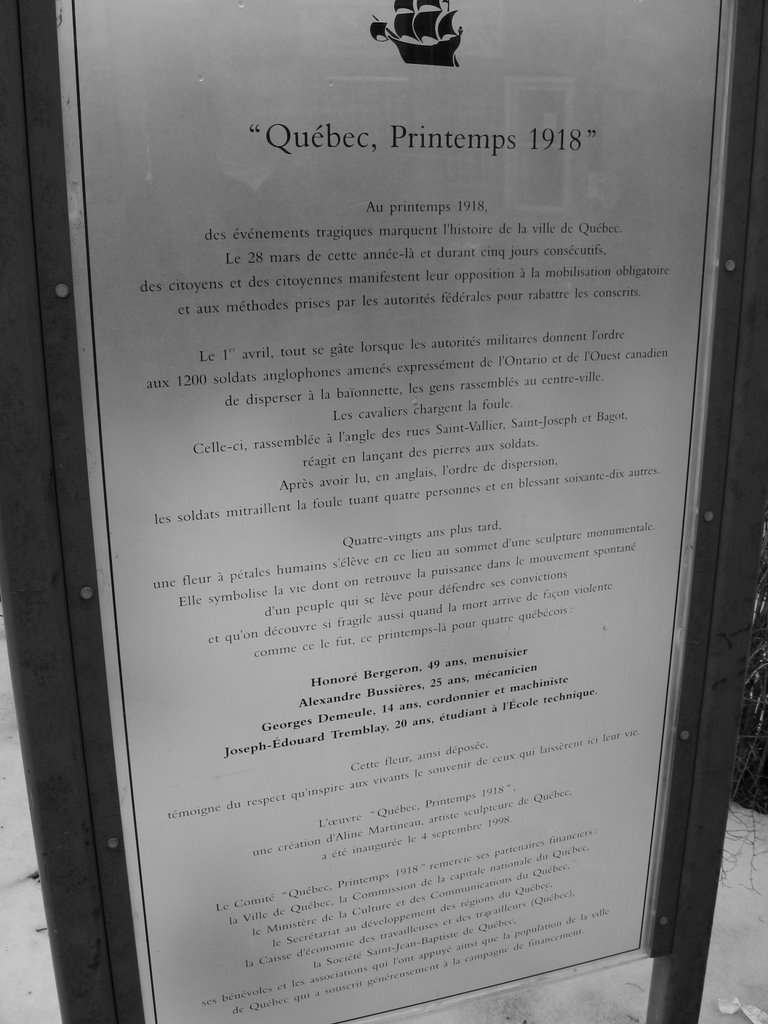
Québec, Printemps 1918


The memorial pictured here commemorates the Quebec City riot of Easter weekend, 1918 [1]. It sits in St-Roch, a predominantly working-class neighborhood in Quebec City. It is right beside a bus shelter. In fact, part of the memorial (not pictured here, but directly to the right of the column) acts as a functional bench for those waiting for the bus.

On 1 April 1918, in this very area of St-Roch, soldiers from Ontario reacted to civilians whose opposition to conscription had turned violent. A lengthy text panel accompanies the stele. Named for Jean Provencher's 1974 play "Quebec, Printemps 1918", the text tells of the riot. If you click on the photo and zoom in, you can read the text. Alternatively, there is a Wikipedia page on the memorial that includes its full text.

The text tells that, for five days, citizens mounted active opposition to conscription. It tells that the federal government used anglophone soldiers from Ontario and the West to deal with the rioters. After reading the riot act in English only, it continues, the soldiers fired on the crowd, killing 4 and wounding 70 others. The panel explains the monument's symbolism, and lists the names of the 4 killed.

One of the friends I traveled to Quebec with this past weekend is writing his Master's thesis on the memorial. Chris is investigating the history it teaches, and the kind of memory it perpetuates. I am really looking forward to reading his work when it's finished, as, aside from what he told us in Quebec, I know absolutely nothing about the conscription crisis. I knew that there was some unfortunate thing called a conscription crisis, and that it featured some pretty angry Quebecois. This is likely, in part, a result of my failure to pay close enough attention in junior high Canadian history. But, wait: I wasn't a terrible student in junior high. I was even actively interested in history. I would like to think that, if the Quebec City riots had figured large in the curriculum, I would retain at least some memory of them.

I attended junior, and senior high school in Toronto from '93 - 2000. In those years, the story of the First World War that I learned of was about Vimy and Passchendale. It was about Canadian women on the home front. I just finished reading Jane Urquhart's The Stone Carvers; it's a fascinating and engaging read, and one that entirely corroborates the WWI story I learned. I'm quite sure my WWI story did not include any more than passing reference to opposition to conscription in Quebec. My WWI story certainly was clearly not heavily inspired by Provencher [2].

Another friend of mine, now doing PhD work in Canadian history, attended public school in Shawinigan in the mid- to late'90s. This likely sounds naive, but I was completely amazed to learn that his WWI story had not included the battlefields of the Western front. His was, it seems, more of a social history of Quebec, and a story of of tensions between local, provincial and federal politics and politicians of the time.

Standing in front of the Quebec, Printemps 1918 monument (and helping us to translate its text) Chris explained that there are huge inaccuracies in the story it tells. But who, in St-Roch, we wondered, would question its narrative? Further, if someone were to wonder at it, what would it take for him or her to research the history, and to challenge the narrative? We then started to wonder about the stories that monuments in Ontario had told us - stories that seemed so straightforward that we had never questioned them.

I'm not, in any way, trying to illustrate conspiracy, or propaganda. I don't know enough about the history of the conscription crisis in Canada, or about the ins-and-outs of our nation's different WWI narratives to do so. I just wanted to take a moment to reflect on the scope, and power of Canadian memories. Not until this past weekend did I appreciate just how disparate memories in Canada are, and will likely continue to be.

------------------------------------------------------------

[1] See the Newspaper Extract, "Five civilians shot by soldiers in Quebec City
April 2, 1918" on the McCord Museum's Keys to History online exhibit
. I wrote a blog post a couple of months ago on the success of the McCord's online exhibits, and of the tagging and collecting functions that the My Folders function allows the museum's online visitor over digitized artefacts. I googled "quebec city 1918 riots", and the McCord's page, complete with a digitized image of La Presse's 2 April '18 page, was the fourth result listed. The page offers a short history of the riot, explaining its connection to the conscription crisis. While this page is useful, I will criticize the lack of navigation tools it offers me. I came at this artefact through a 'back door' - that is, by arriving at the precise artefact via my broad Google search. It seems that the artefact is, however, a part of someone's Folder of collected items. The Folder is unnamed, and I can't find a link to provide me with some context to understand who created this Folder.

[2] See Jean Provencher, Québec sous la loi des mesures de querre, 1918 (Trois-Rivières: Boréal-express, 1971). My friend who is working on this thesis told me that Provencher's interpretation remains the seminal Quebecois work on the conscription crisis.

Monday, December 18, 2006

Wolfe, in all his glory

Three good friends and I just got back from a 4-day road trip to Quebec City. Though we spent most of our time in Vieux Quebec, on Saturday we ventured as far as Battlefields National Park - better known as the Plains of Abraham. It was a damp, chilly afternoon, and we didn't linger very long on the windy Plains before going to get a big bowl of chocolat chaud. We did, however, see a good number of monuments while in the park. Of those we saw, the plaque pictured above is my favourite.

Three things about this plaque caught my attention. First, of course, was its outrageously old-fashioned-sounding text. With the issues that Litt, Wood and McKay raise on the topic of commemoration still fresh on my mind, I thought that it would be great to have a short informational plaque beside this one to state who put up the plaque, when they did so, and if, or, more likely, how it had been defaced in its lifetime.

Second, I realized, the plaque tells its colourful story first in English, followed by a French translation. We saw other plaques in the park that marked the position different divisions had taken on the day of the battle. They were of the same standard shape and size as this little one of Wolfe's. I wish I could remember now if any of the other such plaques featured their English text first, or if that primacy is reserved for ol' Wolfe, alone.

Third, this plaque's bombastic story seemed completely incongruous to the physicality of the monument itself. The plaque is embedded into a slab that is about the size of a modest gravestone.

As anyone who has been to the Plains will know, a tall column marks the spot where Wolfe died. The column is a short walk away from the small plaque. Four bronze plaques cover the four faces of the column's base. One reads, simply, (in French, followed by an English translation), "ICI MOURUT WOLFE LE TREIZE SEPTEMBRE 1759". There's really nothing noteworthy about that inscription. The other three plaques are, however, much more intriguing, as they relate the column's biography. They state that five successive Wolfe memorials occupied the spot. The first, they teach, was nothing more than a stone rolled to the spot after the battle in 1759. The British Army in Canada built a memorial in 1832. It was subsequently "destroyed" (how? why?), thereby forcing the Army to build another one in 1849. In 1913 the National Battlefields Commission built the 4th installment which "reproduced" the column of the previous incarnation. Finally, the Commission erected the 5th memorial in July 1963 "in replacement of the column which was destroyed on March 29th 1963."

What a story! It's too bad the column doesn't tell its visitor why the darn thing was destroyed so many times. Or, on second thought, is there value in sparking the visitor's curiosity so that she might try to uncover explanations on her own?

I really appreciated Kevin Marshall's comment on my last post that history is "messy", and that it "spills away from a historic site in a way that plaques can't possibly illustrate." Thanks, Kevin! I like that description. I do wonder, though: Might Wolfe's column - as much a memorial to itself as a memorial to the General - be a successful complement to the unabashedly old-fashioned Wolfe plaque that my friends and I encountered first? Might the odd combination of those two markers urge anyone intrigued by what their texts avoid stating outright to learn about, say, what was going on in Quebec City in '63?

Wednesday, December 13, 2006

Public History as Interruption?


On the afternoon of Sunday 19 November, there was a bright yellow parrot in the William's Coffee Pub on Richmond St. A dapper looking older gentleman brought the bird into the shop with him. Man and uncaged bird sat together at a booth for a moment, watching the world go by. Then the bird squawked, hopped down from the booth and toddled around on the floor. The man scooped it up, set it on the table, and went to the counter alone to get a coffee. The bird stayed still, guarding the booth.

The scene, of course, woke me out of the stupor that reading the aforementioned, remarkably uninteresting, Europe in the Sixteenth Century textbook had put me in. The bright yellow bird also startled others. One young couple headed to claim the booth and, when they saw the parrot, were visibly discombobulated. They looked at each other, at the parrot, and then around at other customers ( who, like I was, were watching & waiting for their reaction). I could almost hear their thoughts - are we nuts? Does anyone else see that big, crazy-looking bird? I don't even need to tell you how the after-church ladies' crowd reacted to the scene.

While all of this transpired to my immediate left, two hundred paces to my right, outside the coffee shop and in the middle of Victoria Park, stood one of those stoic iron historical plaques that we had been reading about for that week's Public History class. The plaque commemorates the British Garrison in London.

The crazy parrot-related confusion on my left and the staid, quiet plaque in peaceful Victoria Park on my right seemed to occupy two entirely incongruous realities. Our commemorative plaques, I reflected, could do with being a little more like bright yellow parrots. Without tearing down all of our country's classy-looking little iron beauties (an act that would not only be expensive and wasteful, but would likely anger many[1]), perhaps we can update some of them. Perhaps we can infuse them with a little bit of the surprise value that the vision of a tropical bird in a London coffee shop engenders.

The plaque in Victoria Park waits patiently for the passerby to approach it. It is silent, and passive. This is all fine and good, as I'd imagine most of us don't want to be harassed by a commemoration when all we're after is a good coffee on a Sunday afternoon.

But what if we made even some of our plaques active? [2] What if we designed some of them to interrupt our busy activities? We have the means to make the public history equivalent to that yummy smell that Saint Cinnamon pumps out of its store - the one that makes you stop and take notice of your surroundings when you're barreling through the mall, too occupied with your Christmas shopping to really take note of anything extraneous.

American artist Shimon Attie installed a project in Berlin's Scheunenviertel district in 1992 titled "The Writing on the Wall." It consisted of slides of Jewish life in the '20s and '30s, projected onto the façades of the same, or nearby addresses in the district. Attie had been trying to make transparent the process of change through time, and, in this case, the loss of a people from Berlin.[3] Another similar temporary installation in Berlin was designed so that passerby set off a sensor which activated a projection of a short fact, such as, at this intersection, on 23 April 1943, Gestapo assembled 23 young German Jewish women from this community for deportation to Ravensbruck.

In my view, five factors work to make such a commemoration powerful:

1. Its 'surprise factor' - it instantly animated an otherwise innocuous-looking space,
2. it's relationship to the pedestrian - it appeared only when he or she occupied the immediate area,
3. the fact that it was a temporary art installation,
4. the fact that the event it commemorated took place at the exact spot where the commemoration now stood, and
5. that the Holocaust has become iconic in Western cultural memory

Now, clearly, there aren't any sites in London, ON, at which violent acts that would later be identified as part of the Holocaust occurred. I believe that the first four qualities on the above list can, however, be integrated into ongoing commemoration projects in a London context. Furthermore, I remain inspired by Carling's suggestion (made in our last Public History class, and reiterated on her recent blog post) that the Museum of Jurassic Technology struck her as more of a permanent art installation than a museum. I think that if public historians can fully embrace planning that places public commemoration in the realm of (permanent or temporary) installation art, as well as in the realm of history, we could create some genuinely dynamic projects.

Imagine, for example, walking by a normal-looking storefront on Dundas, say, just east of Richmond, when suddenly you hear,

"Hey, you! Yeah, you. You in the purple sweater. Beatrice McPherson lived here in 1911. She was very poor, and she lost her few belongings in a fire that same year."

This noisy commemoration could also (assuming it was programmed somehow) offer conflicting viewpoints of how Ms. McPherson's residence met its fiery demise. Half of the time, it could repeat one popular rumor that gained currency after the fire: that ol' Bea set the fire herself in a suicide attempt. The other half of the time it could repeat another: that the shopkeeper below was the arsonist.

This Ol' Bea example is fabricated (I don't know if there was a Bea on Dundas in 1911, and, if there was, I sincerely hope she didn't suffer a devastating fire). Further, an active monument isn't an original concept. In previous research projects, I have run across countless examples of what many refer to as "countermonuments" - projects that seek to challenge monuments' traditional form - in Germany. I'm certain they exist elsewhere.

The aim, however, of our hypothetical London example would be to work against the relegating of history to quiet, passive and often cordoned-off spaces [4]. Unfortunately, I'm sure we could all imagine that even the noisiest, most aesthetically interesting memorial could quickly become 'invisible.' It could only be a matter of time before the pestering memorial could become completely ordinary to Londoners.

Ideally, then, Ol' Bea would only be a temporary installation. Better yet, it could be one in a series of related commemorative installations. There is, after all, nothing more historical than constant change [5]. If we could attach such noisy plaques to places in the city that are in flux, (such as construction sites), we could work to animate commemoration.

Of course, Ontarians can boast a wealth of existing memorials and commemorative plaques. I would never advocate abandoning traditional memorial forms. I simply think there is much room for creative additions to our current memorial landscape.

-------------------------------------------------------------------------------
[1] Paul Litt wrote of being reprimanded by an angry Torontonian who caught him in the act of replacing an old historical plaque in the city's Beaches area. "You are taking away our history", the elderly man had yelled. Litt's article charts the history of our historic plaques. Although he determines that many plaques are now artefacts in themselves, most Ontarians continue to see the merit in our provincial plaque program. See Litt,“Pliant Clio and Immutable Texts: The Historiography of a Historical Marking Program,” The Public Historian vol.19 no.4 (Fall 1997), pp.7-28.

[2] Patricia K. Wood's writing on historic sites that strive to re-animate the past led me to think about making commemoration noisy, and active. Wood criticizes, in particular, how living museums in Calgary physically relegate attempts at re-animating the past to suburban sites. If she so chooses, the Calgarian could entirely avoid living museums in the greater metropolitan area. Wood raises interesting questions: how can we make successful commemoration projects not only present in the city core, but also relevant to those who live, work, and travel there? How can we make sure that we integrate material commemoration of the past into our dynamic, and ever-growing cities? See Wood, “The Historic Site as a Cultural Text: A Geography of Heritage in Calgary, Alberta,” Material History Review (Fall 2000), pp.33-43

[3] See Eyestorm's 2003 article on Attie's work for some photographs of his installations.


[4] Again, Wood's critique of living museums in Calgary underscores the problem of keeping history in pristine, artificial areas outside of where 'real' people live, work and play.

[5] Ian McKay has written about the politics of public commemoration in Nova Scotia from 1935-64. His article tells that new kind of history for tourists' consumption in NS in that period was “profoundly anti-historical.” Instead of presenting change through time, McKay argued that bureaucrats and promoters sought to freeze a moment in time, for example, in an all-too-perfectly restored building. See McKay,“History and the Tourist Gaze: The Politics of Commemoration in Nova Scotia, 1935-1964,” Acadiensis vol.22 no.2 (1993), pp.102-38.

Tuesday, December 12, 2006

a sense of belonging in a new home

All of us UWO Public History students have had the opportunity to conduct at least one interview in the course of our research for our Museum London exhibit. I genuinely enjoyed meeting with my interviewee. He is a collector of one of the technologies that our exhibit will feature, and he was most generous in sharing his time, and items from his personal library, to aid our research.

Furthermore, the whole experience really heightened my sense of belonging in London. The interview occurred about a month ago, during the same week as some of my colleagues and I returned to Museum London's artefact storage facility to examine the material a little more closely than we had on our initial trip in September. It was also during the same week as our Understanding Archives class took place at London Life Insurance, right downtown. The London Life building, the Museum, and my interviewee's house are all within walking distance of my own house, and of Western. By the end of the week, I was struck by how much more comfortable - by how much more at home - I felt in London. My sense of the geography of the city had expanded along with my sense of the city's identity and, of course, it's history. I had also begun to reflect on my own identity, and place, in this city.

Whether we are new to a given community or have lived in it for years, oral history and local history have great potential to heighten our experience of belonging in that community. Conducting oral history interviews and researching local material culture are a couple of ways to build up relationships between people. They can also help us construct (or build on existing) networks of local places, spaces and institutions. Finally, of course, such community research facilitates our sharing of information.

Community institutions such as churches, libraries, museums, galleries, theatres and regional, or municipal parks commissions are ideal candidates to lead community members in recreational oral history, and local history projects. If we could secure federal or provincial funding for those projects by explaining their potential for community-building, we'd be on our way. If we incorporate the building of an online, easy to use, open access digital repository for all of the information gathered an integral part of the project itself, I think we'd really be cookin'. Contributors would have the opportunity to hone their technical skills, too.

Today, there is truly an overabundance of opportunities for us to travel internationally. Work abroad programs, study opportunities, travel, internship and fellowship possibilities invite us to make virtually anywhere a new home. In our world, so many of us move around so much. Participation in discovering the history of the place we reside can amplify any interpersonal connections we make in a new home. Historical research has the potential to not only combat the newcomer's sense of dislocation, but also to help her become an active participant in the community.

Why can't I reflect in real time?

The last time I posted a blog was 18 November. That’s almost a quarter of a term ago. It doesn’t need saying, but I’ll say it: I’m clearly having trouble being active and reflective at the same time. My colleagues have figured it out, and I am inspired by their accomplishments. What ‘action’ has kept me from this blog?

  1. Museum text panel editing
  2. A presentation about what makes for an archive's successful educational outreach initiative
  3. A paper on how public access should be paramount among libraries’ mandates
  4. Interview transcribing
  5. Lately, shoveling. No matter how many times family cautioned me, I didn’t fully appreciate the “London is in a snow belt, y’know” comment until, well, last Thursday’s illustration.

We have all faced the challenges that assignments, deadlines, and inclement weather have mounted over the past few weeks. Once again, I commend my fellow public history students (please see the “blogroll”, at right) for their success in managing to meet such challenges, and to blog about their experience in real time. Our History 500 syllabus suggests that we're to "engage in 'reflective practice' throughout the term, responding to readings, discussions, and experiences as they occur."

Sigh.

The opportunity to post a blog on something that occurred in (even relatively) real time in invaluable. I've been fortunate to have had this experience a few times this term. The resulting blog post can, I think, really convey my excitement, wonder, or confusion about the subject at hand. In contrast, my scribbled, coffee-stained notes about an idea that I found engaging three weeks ago are certainly not inspiring sources for new blog posts.

Professor Turkel's History 513 syllabus reinforces the value of blogging in real time. It encourages us to use our computers during seminar meetings to look things up on online, to blog about the discussion, and even to "send backchannel text messages to other people in the room"! These are exciting, inspiring suggestions. If I could manage to act on them, I think some really dynamic writing could be the result. I just need to figure out how to operate in the 'real world' and the 'digital world' simultaneously. I do, however, strongly dislike that 'real'/'fake' world distinction. So, better yet, I would like to figure out how to conflate action and reflection - to make them, as I wrote in an earlier post, integrated layers of one big activity.

Sigh. It's an ongoing challenge. For now, I will have to settle for dusting off, and hoping to re-invigorate, some of those two- and three-week old reflections.

Saturday, November 18, 2006

experimentation

Pursuing my aim of rendering the learning process transparent, I've included some of the HTML that I created on W3Schools' "Tryit Editor v1.4" In so doing, I've suddenly realized that what I thought was a great idea (about exposing one's learning curve in a very public way, as, in this case, on the Web), is, instead, really a pretty arrogant one. I can imagine that, in most cases, nobody besides the creator cares about her learning curve, or process. Who wants to follow that process? Who has the time? I suppose it depends on how exciting the researcher's process is. Clearly, though, learning to write HTML isn't the raciest research activity to lay bare, is it? This is particularly true when (as in this case) the content will read as nonsense to anyone but the creator.

Mushaboom
this is a really cute song
it really reminds me of sarah cooking in our crazy kitchen, looking out the window at winding snowy staircases, winter 2004

Let it Die


I like to sing this one out loud
even when and where I shouldn't
like in the TA office, when I'm using my headphones and I'm sure noone else is there
but someone is always there!

Just because it has attitude...


now I know what I don't want - I learned that with you but why is that quotation bolded? Ah, right. Didn't close the bold tag above
"now i know..." is the only advantage to using the quotation tag (instead of just inserting a break tag and then typing in the q. marks myself) that the quotation marks look nicer?


They shot a movie once in my hometown
Everybody was in it for miles around
Out at the speedway, some kinda Elvis thing
Well I ain't no movie star
But I can get behind anything
Yea I can get behind anything
heh!


Poor Sarah


It's no time to be sad


this is a pretty crazy feature

what can I use it for, beyond writing Hebrew text?


I'm all over the p, and b tags!


I like headings


They organize things

This is a heading


I like headings


but I don't like blue

I just have to remember to use american spellings for "centre" and "colour"

Obviously, the next step is to learn about Web Hosting.

This is a post-posting note: I wasn't prepared for blogger to read this HTML in any way - I copied and pasted it from notepad, and thought it would appear just as it does there. I'm perplexed. The learning curve is temporarily leveling off.

Tuesday, November 14, 2006

Mozilla!

Thank you, firefox. I have not been able to post pictures to this blog for a while, and Blogger indicated (in a not-so-subtle way, with a "get firefox" link) that I should just change my browser, and everything would be fine. Blogger was right. I don't miss my slow, cumbersome Internet Explorer at all. Pages now take no time to load. The tab system is fantastic. My blog is a more attractive colour viewed with firefox than it was with IE, and this fabulous new browser even looks more sophisticated than the one I had in IE. I know, I should have jumped on the firefox bandwagon years ago. I'm just glad I finally did.

A latent historical consciousness?

Two years ago, some of my fellow Concordia history grad students and I organized a conference entitled "Nations, Nationalism, and National Identity." Ambitiously, we asked Benedict Anderson to be a keynote speaker. He respectfully declined. Instead, Jocelyn Létourneau came.

This week's focus on history and nation-building recalled my experience of working on that conference. Aside from Létorneau, I don't remember any presenter speaking on identity and history in Quebec. Thinking back on that fact now, I find it really surprising. What surprises me even more is the fact that none of the members of the organizing committee (myself included) even noticed this void at the time [1]. Our history conference, held in the middle of downtown Montreal, in a province where every licence plate reads "je me souviens," almost entirely failed to shed light on history and nation-building in Quebec.

Was that a failure on our part? Should our location and context have made us responsible for increasing emphasis on the Quebec case? [2]. At the time, I was taking a course on Public Memory in Canada, taught by Ronald Rudin (who stars in Lorenz's study) [3]. One of the essays we read in that course was Nelles' work on the Tercentenary of the Founding of Canada [4]. Shouldn't our event's lack of Quebec-ness have resonated with me?

When do people reflect on their identity? And when do they couple history with that reflection? Is it only when, as in Nelles' study, they're involved in nation-building? What about the majority of the population - those of us who haven't made front page news (like René Lévesque) for our nation-building activity? Sure, we may think on our history and identity in times of crisis (such as during a World War, or a referendum on sovereignty when identity is threatened). What about at other times, though? It didn't occur to my friends and I to think about how our own history and sense of identity could affect the way we shaped our conference. Létourneau and Moisan's conclusions corroborate my experience. Their study of the persistence of a dated historical memory in Quebec infers that young people haven't been thinking actively, or independently, about history, nation-building and community identity.

I am interested to hear my colleagues' views on communities' historical consciousness. Do we keep our sense of historical identity on the back-burner? If so, when do we call on it? In those instances, what do we use it for? How can we (as public historians) facilitate communities' use of history for constructive ends?

----------------------------------------------------------------------------
1. I would guess that at least half of my fellow history grad students were from Quebec. I can't, therefore, say that our topical void was the result of a bunch of oblivious Ontarians working on the project!

2. That a university, or museum has at least some responsibility to teach about the history of its vicinity is a thought that keeps rattling around in my head. Someone expressed this idea in class a few weeks ago, when we were talking about the McCord. I can't remember who it was - my apologies! - but thank you for sharing it. I think it's a really important notion.

3. Chris Lorenz, “Toward a Theoretical Framework for Comparing Historiographies: Some Preliminary Considerations,” Theorizing Historical Consciousness, ed. Peter Seixas (Toronto: University of Toronto Press, 2004), 25-48.

4. HV Nelles, “Historical Pageantry and the ‘Fusion of the Races’ at the Tercentenary of Quebec, 1908,” Histoire sociale / Social History 29 no.58 (November 1996), 391-416.

Thursday, November 09, 2006

on a side note...

On a side (though somewhat related) note, in the class Carling and I T.A. for, we've been learning about the Reformation. "How did the press affect the spread of Luther's message? How did that technology affect the relationships Luther shared with his supporters and, most significantly, his critics?" These were two of the questions we encouraged our students to think about last week. We were trying to encourage thinking beyond the notion that Luther's message spread much more quickly with the use of the press than it could have otherwise. We were trying to convey the notion that, once his ideas were in print, L couldn't very well evade persecution by saying, "what? Are you kidding? I never said those things!" Of course he said those things - and his critics had a multitude of publications kicking around to prove that he did.

Wednesday, November 08, 2006

Integrated layers of one big activity (or, an apology post)

I am very uncomfortable with something I wrote in my post a few days ago. I actually didn't write it, but implied it - and this is much worse than if I had actually written it. Often, I think, harmful things implied are much more detrimental than harmful things declared.

What is this "something" that makes me so uneasy? Well, on Sunday, I wrote of my new resolution. I resolved to spend less time sitting around thinking about public history in general, and about digital history projects in particular. I implied that my time would be much better spent larning how to implement projects that I could eventually realize. Worse still, I may have unintentionally paired the act of reflection with my clunky, defunct printer, and that of action with the "sexy" Web.

Yes, I know, my blunder is far from earth-shattering. It has, however, troubled me. This blog is, after all, part of my public persona. What if a reader thinks that I - gasp - believe that reflection and action can't co-exist? What if I'm conveying a sense that the grad student should think less and do more? That would be terrible. I advocate a philosophy of learning completely opposed to such a model. This is my apology post.

Of course, action and reflection should, ideally, co-exist in any learning experience. It seems to me that even pre-school lesson plans are based on this idea. I have a dusty memory of listening to a story about teddy bears in daycare. Afterwords, we drew and coloured-in scenes from that story.

Fast forward a few (ahem!) years, and we're learning in layers this fall. These layers are integrated. They're part of one big activity. We're reflecting on what museums should do, and we're working really hard (and are losing sleep) to make an exhibit. We're learning about "the Infinite Archive" and we're trying to make web pages. And, just before you think this post contains nothing but schmultzy, overly-generalized reflection, let me bring it to a concrete example.

Right now, I'm tyring to figure out the best way to merge my desire to play around with webpage building, or even wiki writing, with the need to document and organize my ongoing artefact research. In our meeting about the Museum London historical exhibition we're developing, we discussed the problem of how to make visible (to each other, to our public, and to our Professor) all of the research that we've each put into this group project. The problem, of course, is that a short item label for the museum exhibition can't convey the depth of our work.

My solution so far has been this: I have been using our wiki as a sort of repository for the best (as in most useful for our purposes) bits of my research. In so doing, I'm afraid I may have caused some frustration on the part of my more organizationally-minded colleagues, who - rightly so - would like a streamlined wiki. I apologize for that! I do, however, find the wiki a convenient way to organize my material. To keep from making too many enemies among my colleagues, I would like to play around with using a website as a good repository for my ongoing research. Of course, that requires me to build a website. I stand by my resolution to try to do this - though, currently, other demands are keeping me from "getting down to (more of) it" as quickly as I had hoped.

A website, as we read many weeks back, allows for doing history in hypertext. Now, I'm really inspired by notions of harnessing the web, and harnessing our participation in developing the web, to extend the potential of real, living, working communities. I'm drawn to the idea of making my ongoing research transparent to the viewer on a website precisely because I think it has great potential to make the relationship between me and my colleagues, and the relationship between our exhibition production team and our consumer, really dynamic.

We have the potential to take the historical research that we do in the university library, and that we cobble together behind card-swipe entry only T.A. room office doors, into a public environment. That public environment is becoming increasingly user-orientated. What better way to make our hard work useful to the community than to plant it, in "raw" form, (that is, as a "work-in-progress", and not just as a final result) on the web?

I understand that, in many cases, it might be inappropriate of the public historian to make her research process transparent. Yet, I think that in others, the public historian has opportunities for forging dynamic relationships with her audience right from the first stages of her research - and she can forge those relationships by rendering her process as transparent as possible.

Unfortunately for us UWO PH students, we are working under a strict time deadline to get our research done and "cooked." This reality prohibits much experimentation with innovative ways of doing and presenting our research. Deadlines are things of the real world, though, and I don't decry our situation in any way. I'm just reflecting on what the great potential of our combined work, fuelled by our ongoing learning. There we are: action and reflection are together again, after a brief but heartbreaking separation on this blog. Phew! I feel better.

Monday, November 06, 2006

Getting down to it

I took some time this evening to work my way through W3School’s Web Building Primer for the beginner. In the very first section, I learned that there is a World Wide Web Consortium that makes rules and standards for the Web. Really? Are they pulling my leg? There can’t be. I sure hope that, if there is such an entity, there’s a very Jean-Luc Picard-ish figure at its helm. Ah, Jean-Luc. "Make it so."

Right away, I appreciated W3School’s simple interface. One of my favourite features was the table of contents in the left-hand margin section of the page. I like knowing where I’m being led, and, as many of us have commented this term, it is always great to know how much one has to read. Will this be a 5-minute long project? Will it take me all evening, or a couple of hours? The layout gives its user a clear sense of her location.

On a side note, I really do think that we should offer our visitor a mapping statement – a sentence explaining the major themes, in the order they will appear, for example - on the first room’s title wall of our Museum London Exhibit. We could even be very clear about it, and tell our visitor in this panel something like, “…you will see x, y, z…”, etc. We don’t want our visitors to feel lost, or as if we’ve left them to their own devices to make sense of our project.

Back to Web Primer: I learned that XML is for describing and transporting data, while HTML is for displaying data. I look forward to learning what all of that means, in real terms, shortly. I also learned that Carling was right (not that I would ever doubt her): it is great to learn to write HTML using a plain text editor instead of a WYSIWYG one like DreamWeaver. I will pick up the tutorial tomorrow at the “CSS Primer: What is CSS?” stage.

So far, I’m finding the tutorial fantastic. Well, almost fantastic. I ran into one small snag. “Do you want to try it?” the tutorial asked me, after it had explained the basic features of an HTML file.

Well, I thought, of course I want to try it. What a silly question.

I couldn’t make sense of the explanation for doing so, though. The tutorial tells me I’m to open word pad, but what is OSX, and how do I get “in” it? Where is TextEdit, and how do I “start” it? This little roadblock is frustrating, and I wish the instructions had been clearer as to how the beginner can access these requirements.

Despite this wee stumbling block, I must admit that I find all of this very exciting! The big scary Web seems so much simpler to me now. I do, however, have an awful premonition that my happy state will not last long, provided that I continue learning about how to be a Web participant. I took a historiography course in the 3rd year of my undergrad. It was my first introduction to the scary concept of historiography. On the first day, our professor told us that we should imagine our ideas of history as represented by our good ol’ friend Humpty Dumpty. Over the course of the year, he told us, we would boot HD off the wall, and he’d smash all over the place. He would make a big, smelly, sticky mess. My prof. assured us, however, that we would, in time, right HD once again. His cracks would be visible thereafter. I am sure that my notion of the Web as lovely and friendly and relatively simple is the attitudinal equivalent of the moment before poor, naïve Mr. Dumpty topples to his messy (though not fatal) doom.

Sunday, November 05, 2006

A resolution

My printer isn't working. My printer isn't working, and it's driving me crazy. I think it's on bad terms with my computer, because they don't seem to want to talk to each other. Early last evening, all I wanted to do was to print off notes for my tutorials on Monday. I needed, I felt, to just be able to cross that one, simple task off of my to-do list.

Printer and I took some much-needed time apart. The crazed anger that had made me want to pitch printer out of my second-storey window subsided.

In fact, my hardware crisis sparked a personal revolution - well, maybe just a resolution. I will not be daunted by my old, bulky Lexmark contraption. I am resolved to spend less time responding to tired, clunky hardware and more time participating in the much sexier Web 2.0 [1].

Tim O’Reilly (as quoted by Paul Miller) writes that the new Web is the “…network as platform…” [2]. I find this a most exciting concept! I remember that Diana, at the beginning of term, wanted to know how aspiring practitioners of public history could “come to the table” with individuals like digital historians and web programmers to “do” real history. I also remember Kris, again at the beginning of term, wondering when she could start being a historian [3]. In the former case, Bill Turkel’s response to Diana was “you’re at the table!” In the latter, Kris had been responding to Alan MacEachern’s question, when will you stop being a history student and start being a historian? [4]

Public history is, as we discussed and are learning, a reflective practice. I truly believe this to be a constructive, useful and inspiring way for its practitioners to conceive of their discipline. I need, however, to strike a better balance than I currently manage between reflection and action. I need to continue to write blog posts about the kinds of digital history projects I'd like to eventually be involved in making, and, at the same time, get down to learning about how to make them [5].

I am, therefore, resolved to spend time for the remainder of the term with W3Schools, learning how to make my own webpage. All of Carling's hard work on her genealogy and Jurassic Park pages has motivated me to action. Perhaps I should start with Microsoft Publisher (despite Carling's disappointment with the program), or at least with DreamWeaver? I would like to start from the "basics", as Carling commented, and so I think learning XHTML is the best way to go about this project.

I do recognize the irony in my resolve to take up the mighty challenge that only rates an "easy" on Bill Turkel's thermometer difficulty scale for lab exercises. Further, I recall Tim O'Reilly's distinction of personal websites, the concept of pages, and the act of publishing among those features characteristic of Web 1.0. I do, therefore, also recognize the irony in taking on personal web page making as my first step in participating in the new Web.

Now that I've publicly resolved to take on this project, I'd better stop talking, and just get down to it.
--------------------------------------------------------------------------------

[1]. Hats off to my colleagues Kevin and Kelly for an enlightening and entertaining blog-off on, among other important topics, the sexiness of the apple corer.
[2]. I know that I came across the explanation – somewhere in the Digital History readings for this coming week – that we’re treating the Web as a platform just as we only used to think of operating systems as platforms. It was likely in the same spot as the helpful explanation that, sometimes, people express this concept as “web as operating system.” Of course, I can’t remember, or find again, this helpful spot to cite it. If anyone comes across it, I’d so appreciate it if you could let me know of its location.
[3]. Kris comments on this experience in one of her blog posts.
[4]. I’m wary of mis-quoting Professor MacEachern again, lest he think all the PH students are orchestrating a massive smear campaign. My memory of the conversation is muddy, and so I intend only to paraphrase.
[5]. For example, I'm still intrigued by the idea of a network visualization interface for Canada's memorial and historical sites, and by that of mapping the human relationships that continue community for now-empty physical (spatial?) communities.

Saturday, November 04, 2006

On Human Networks

I have a knot of thoughts clogging up my brain right now. In my mind's eye, the knot resembles that representation of a protein interaction network that I included in my post about visualizing complex networks. The difference between that complex network and my thoughts, however, is that my thoughts are all very simple. They've just managed to get all tangled, like that big ball of outdoor Christmas lights that has sat in the corner of the garage since last January.

I think the knot is both a result of my long silence on this blog, as well as a reason for the continuation of that silence. Over the past few weeks I've been scribbling wee notes to myself full of future blog ideas. These crumpled pieces of paper have been collecting in a pile on my desk. They're intimidating - much, much more so than a small stack of personal notes should be. Of course, they're now of no use to anyone (least of all to me) . I've realized that the moment is clearly not going to come when I'll craft the disparate thoughts into an eloquent essay. So, for the preservation of my sanity, I'll spill them out here. Perhaps I can revisit this mess later and make something more of them. Hopefully, that "something" can be more than just the sum of all of its parts. That would be very satisfying, as the broad subject of my thinking has been networks.

The topic of mashups, and the ecological metaphors some have used to describe them, helped me think about networks in new ways. I published my post on that topic this morning, and then walked down to do some reading at the Red Roaster Cafe in the London Public Library. When there, a friendly guy, apparently interested in the remarkably uninteresting "Europe in the Sixteenth Century" textbook I was reading, struck up a conversation. We didn't even talk for ten minutes, but in that time I learned that he had studied visual art at Concordia, and most likely was in the same courses as one of my close friends.

We often exclaim, "what a small world!" We (as in our world's population) have relationships that comprise a very complicated network. Again, our messy-looking friend, the protein interaction network, could represent those relations. Wouldn't it be neat if everyone could just stand still for a couple of months, and an artistic/research team could run around tying strings between people to represent their relationships. We would all end up the ultimate Christmas light-esque knot.

It all has the makings of a weird Douglas Coupland installation project. See, for example, Coupland's "Super City" piece at the CCA. Indeed, it's likely that many artists have produced work on this theme, and I'd love to learn more about their work. In fact, I would love to take up a project on the theme. Inspired by Visual Complexity's statement "the whole (of a network) is always more than the sum of its parts", I would learn how to make an appealing and intriguing-looking visualization network to represent, and teach about our relationships. I would encourage other interested researchers to use my aggregated data for their own applications. (Really, all of this reading about some of the fabulous components of Web 2.0, such as collaboration, social bookmarking, open-access and open-source applications, peer-to-peer sharing, APIs and recombinance is turning me into a socialist). Inspired by the mashup outside.in, I would seek to map out, locate, and represent the invisible relationships we share. It would be my goal for the virtual community to enhance the actual community.

The first community I would target for this kind of application would be one I'll call the Depot Harbour diaspora. DH is now a ghost town, and is located near Parry Sound. My partner is currently doing a fascinating oral history research project on the place. He has taken on this project because his grandfather used to live and work in the once-thriving community. Mark recently interviewed a number of relatives on their experience with the town, and their memories since they have left. His goal is to bring the people back into historical interpretations of the space - to repopulate the creepy (in a bad way)-looking photos we have now of empty lots where community churches once stood.

After sharing a litre of wine and a lengthy, exciting conversation about his project, Mark got me to thinking that some kind of visual map of the relationships between former DH residents, and of their current locations, would be a really neat thing to have. All of the people moved somewhere, and they took great stories with them. What if we could collect those stories, map them out, and indicate contextual/topical relationships that their stories reveal? Our interview subjects could continually add to this network. (For a visualization of these connections, I'm thinking of using something similar to the "strings" that connect subjects in the McCord's concept network interface).

In the end, isn't it among the historian's goals to repopulate the dusty, dead and now-empty places of the past? I'm looking forward to thinking about ideas of place and community identity-building in our 500 class on 15 November. I think that Chris Lorenz's [1] writing on space, time, and place-in-time opens up neat areas for discussion about the ways communities make identies, and the ways we can learn about the meaning they give to those identities.

Of all of my recent disconnected thoughts, the one most relevant to the current work of our own little community of UWO Public History MA students is that about repopulating past communities of Londoners by using the artifacts at our disposal. Just as a mashup contains innumerable clues about its parent community, so does an apple corer - though, as Kelly has written, that corer could maybe do with being a little sexier. If our exhibit can teach our visitors about the meaning an apple corer, a bovie, a gestetner or a slide projector had in a London community - or, rather, how such inventions affected/were used by the community - I think we'll have done a good job.

-------------------------------------------------------------------------------

[1] Chris Lorenz, "Toward a Theoretical Framework for Comparing Historiographies: Some Preliminary Considerations," Theorizing Historical Consciousness, ed. Peter Seixas (Toronto: University of Toronto Press, 2004), pp.25-48.

Friday, November 03, 2006

Programmable Web and mashups for historians

A web mashup, I’ve learned this week, is a web application that operates by combining two or more pre-existing applications. Unless she hacks the parent site’s software, the mashup creator needs to acquire it some other way. Even if the hacker acts as a sort of Robin Hood – providing precious resources for the poor masses – it seems to me there’s still something essentially unfriendly and competitive about the work she does. In contrast, I am so pleased to broach the gaping chasm that’s been my long, conspicuous and tortured silence on this blog by reflecting on as warm and fuzzy a topic as web remixing.

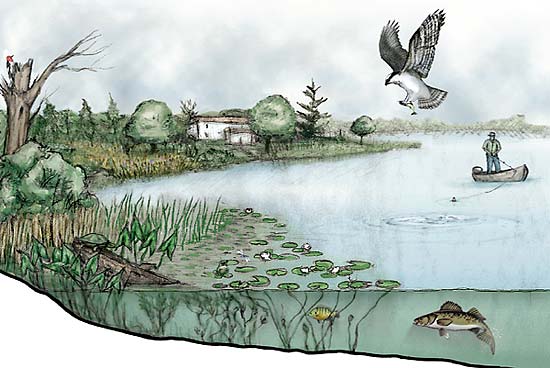
What I’ve learned about Web 2.0 is that it is a friendly, collaborative, social and very human platform. Nardi and O'Day's thoughts on "Information Ecologies"as systems where people help people use technology evoke a sense of human, lively, and intensely organic spaces. It all sounds just lovely, and doesn’t intimidate me nearly as much as did the prospect of reinvigorating this long-inactive blog. The image I've included above reminds me of a third grade lesson on ecosystems (which, in turn, gives me warm fuzzies). It reminds of our friendly Information Ecology: reduce (redundant work) by reusing and recycling (preexisting technology and applications) = a great model for sustainable web growth. As Steve Jurvetson has indicated (and, for how he helped me conceptualize this notion, I grudgingly give another shout-out to Kuhn) this kind of natural growth is marked by evolution - not wasteful revolution - of technologies.

The mashups I browsed through at Programmable Web do correspond, largely, to the prominent genres that Duane Merrill lists in his "Mashups: the New Breed of Web app". Most prominent seem to be those that involve mapping. Remember the Milk combines mapping with task-management, letting users organize their daily tasks by location. Orlando timeshare guide maps properties and matches them with contact details. Also numerous are those mashups that allow searching. The charming and stylish Ms. Dewey helped me learn how to make fantastic chocolate chip cookies, an how to train for running a marathon. She is, I admit, much more engaging than her counterpart, than the slightly-scary "ask Vox" know-it-all. Finally, shopping/sales is another conspicuous genre of mashup. There is, admittedly, a lot of overlap of this genre with that of mapping. For example, MyStoreMaps offers the eBay vendor a real-time map of where she has sold her items.

I must admit that my favourite mashup among those that I came across is outside.in. The idea behind it is just wonderful: it replicates a physical community in hypertext. At the same time, though, it enhances the physical community. The application aggregates information about a neighborhood, city or area - such information, its creators advertise, as local restaurant reviews and notification of community garage sales and high school benefit concerts - and maps them for its user. As its creators describe, outside.in bridges “information space and real-world space”. This really gives me the warm fuzzies, because, by informing individuals about local events, it can enhance community – and the relationships between real people in it. This mashup illlustrates perfectly Nardi and O’Day’s description of Information Ecologies as featuring a spotlight not on technology, but rather on the human activity that the technology serves.

Outside.in reveals the usefulness of mashups as research tools for humanities scholars. Historians should care about mashups because, just like any other piece of material culture, embedded in a mashup are many, many indicators of meaning. Future researchers will be able to use these applications to think on a specific society at a specific moment in time. By virtue of their very social nature, mashups contain innumerable clues to a community's values. What actions, events, spaces or places does a community deem important? Which of their needs have they crafted the mashup to meet? What pre-existing technologies have they deemed successful and appropriate to recombine into new uses? For those interested in how communities construct and reflect social and cultural meaning, mashups can be an invaluable resource.

Friday, October 13, 2006

pushing that old envelope

Actually, at this point, I'm trying to do the virtual equivalent of lighting the envelope on fire, waving it around, throwing it on the table and dancing around it, hooting and hollering and flailing my arms madly. I'm disappointed that my Wikipedia posts have been accepted. I was hoping they would be controversial. The following is my newest addition to the page:

In 1998, German novelist Martin Walser cited the Holocaust Memorial in his public condemnation of Germany's "Holocaust industry." Walser decried the "exploitation of our disgrace for present purposes." He criticized the "monumentalization", and "ceaseless presentation of our shame." "Take all the towns in the world", said Walser. "Check whether in any of these towns there is a memorial of national ignominy. I have never seen such. The Holocaust is not an appropriate subject of a memorial and such memorials should not be constructed..."

I'm starting to worry that I'm the only person in the (English-speaking, Wikipedia-reading) world that gets excited by this subject. It's a humbling thought.